Regular vs blind burrs: What’s the difference?
- Blind burrs have no screw holes on the cutting surface. Instead, they are secured using alignment pins and magnets, or screws from the back or side of the burr carrier.
- This can increase surface area by up to 8% for some models. Some industry professionals and home baristas claim this results in lower grind retention, increased efficiency, and a more even grind size distribution.
- Yet few grinders feature blind burrs, raising questions about manufacturing challenges.
- As burr design continues to evolve, blind burrs could become more popular, especially as the prosumer market demands more cutting-edge innovation.
Baristas and prosumer demand nothing less than precision and consistency, prompting grinder manufacturers to innovate further. Over the last few years, blind burrs have become increasingly popular for this reason.
These are designed without screw holes on the surface to increase the cutting surface area. Manufacturers claim this improves grinding efficiency, minimises retention, and produces a more uniform particle size distribution.
A small body of independent research indicates this is true. Tests conducted by Robert McKeon Aloe, for example, found that coffee ground with blind burrs scored higher across a range of taste descriptors compared to beans ground with regular burrs (or with screw holes on the surface).
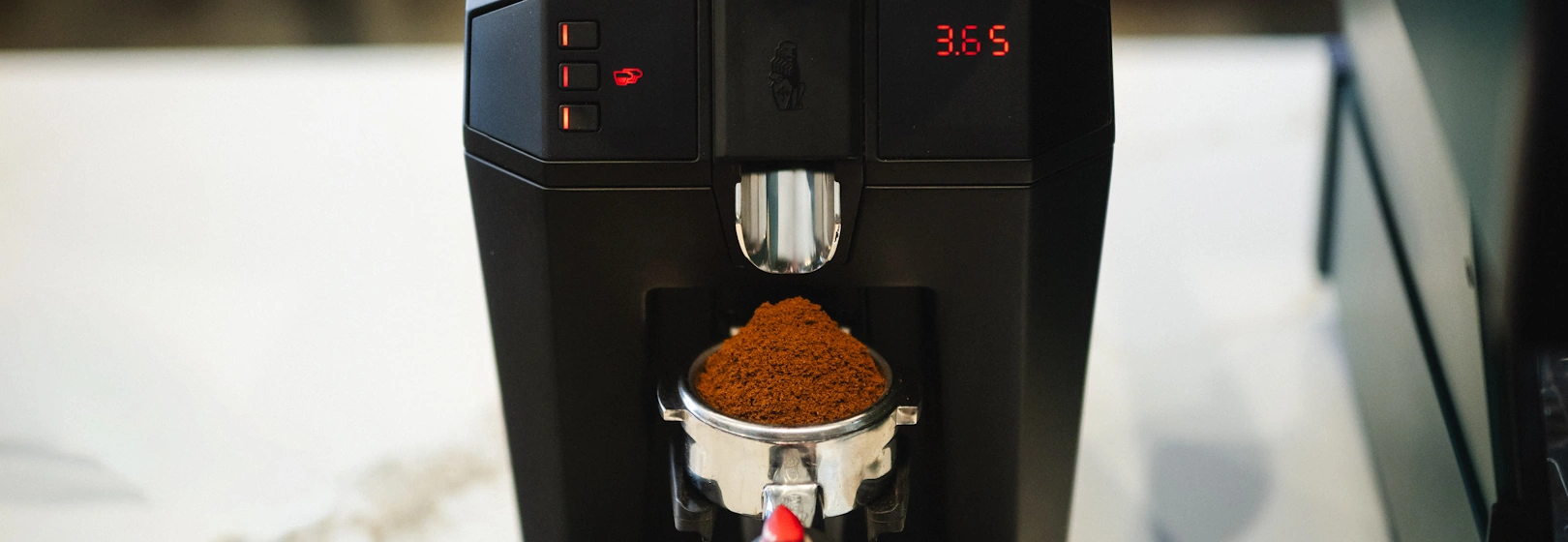
More grinders are featuring blind burrs, including La Marzocco’s new Jay, Ceado’s Life-X, Eureka’s Black Diamond burr set for the Single Dose Pro, and Weber’s DB-2 Ultra burrs for the EG-1. Yet, many models still feature standard flat burrs, raising questions about manufacturing costs and challenges.
Aric Forbing at La Marzocco and independent coffee scientist Dr Robert McKeon Aloe explain more.
You may also like our article on how grinder burr design is evolving.

What are blind coffee burrs?
When using a high-quality grinder, the aim is to achieve a consistent grind size that allows you to extract clean, crisp, bright flavours from coffee.
Flat burrs (two ring-shaped burrs that sit on top of each other) grind coffee horizontally, which results in unimodal particle size distribution. This produces more uniform ground coffee particles, resulting in more even extraction.
Their design, however, can increase grind retention, potentially imparting muddy, stale flavours in the cup if not cleaned and maintained regularly.
“Most flat burrs mount using screws that pass through the cutting face. While this makes it easier to access the screws when the burrs need to be changed, it reduces the surface area for grinding, interrupting the cutting surface,” says Aric, the Product Marketing Manager for premium coffee equipment manufacturer La Marzocco. “These holes also accumulate coffee, adding to retention and making it more difficult to clean.”
The design of blind burrs bypasses this issue.
“The burrs used in the Jay grinder, for example, feature blind screw holes on the back of the burr,” Aric explains. “These holes don’t extend through the cutting face of the burr, which means it remains uniform and uninterrupted.”
For 64mm flat burrs, this can increase grinding surface area by 8%.
“Additionally, it prevents coffee from accumulating in and around the screw holes, reducing retention and making cleaning easier,” Aric adds.
Conical burrs (one cone-shaped burr inside a ring-shaped burr), meanwhile, grind coffee vertically. This results in bimodal particle size distribution, so they produce more of both smaller and larger-sized particles.
“Conical burrs, like those used in our Swan and Pico grinders, employ a different geometry,” Aric explains. “By nature, the conical cutting surface of both burrs is uninterrupted, meaning that a blind burr design isn’t needed.”

Looking at the data: Are blind burrs better?
“Regular” flat burrs typically include three screw holes on the surface, while blind burrs include none. Many coffee professionals, equipment manufacturers, and home baristas claim this improves several factors, including reduced retention, a more even particle size distribution, and better grinding efficiency.
“The Jay’s burr design grinds more efficiently and consistently, thanks to the extra surface area,” Aric explains. “The magnetic attachment of the upper burr also makes it easier to access the grinding chamber.
“Meanwhile, the patented burr alignment system features a spherical surface on the back side of the upper burr, allowing it to align with the lower burr before being locked into place with the mounting screws,” he adds. “This simplifies the replacement process by eliminating the need for shimming or adjusting the burrs, ensuring a consistent grind.”
But does data back this up?
Independent research by Dr Robert McKeon Aloe, using the Zerno Z1 grinder, found that the blind burrs outperformed the standard burrs across seven metrics for espresso: Sharp, Rich, Syrup, Sweet, Sour, Bitter, and Aftertaste.
“It’s true that blind burrs reduce retention,” says Robert. “The retention in the screws adds up. I didn’t measure the exact amount of coffee, and I’m not sure it matters, as it’s unclear how much of those grounds transfer to the cup or remain there permanently.”
Coffee content creator Sprometheus (also using the Zerno Z1) found that the average grind temperature with blind burrs was 30.1°C (86.2°F), compared with 30.9°C (87.7°F) with regular burrs. Additionally, blind burrs ground 20g of coffee at an average speed of 27.95 seconds, while regular burrs ground the same amount in 28.63 seconds.
Regarding particle size distribution, Sprometheus’ findings concluded that blind burrs resulted in a more consistent median grind size for both espresso and filter.
Why don’t more grinders have them?
Sprometheus’ independent research also found that blind burrs resulted in higher extraction yields for both espresso and filter, leading to brighter flavours with more clarity.
Although more peer-reviewed research is necessary, blind burrs appear to offer several benefits. This then begs the question: Why don’t more grinders have them?
“I suspect it’s easier to produce standard burrs, but I don’t think it’s a major cost to switch to blind burrs,” Robert says. “I think more will start to include blind burrs as a way to distinguish themselves from each other.”
There are undoubtedly more manufacturers using them, including La Marzocco, Ceado, Eureka, Zerno, and Weber, but we have yet to see more blind burrs available on the market.
“While it’s not necessarily challenging to produce, the manufacturing of the blind burrs is a bit different from typical flat burrs. It requires a few more steps to incorporate the improvements, so features such as blind screw holes and a spherical surface require more time and effort to manufacture,” Aric explains.
“We’ve applied the same principles used in the design of our espresso machines, utilising high-quality materials to ensure a long lifetime of consistent and reliable espresso.”
Additionally, there is no universal approach to attaching blind burrs. While regular burrs rely on three screws, blind burrs are attached using magnets or screws at the back or side of the burr set.

As specialty coffee standards continue to rise, grinder manufacturers have recognised that burr innovation must be their primary focus. For this reason, blind burrs are likely to become more popular.
All the evidence indicates that blind burrs can have a positive impact on the cup, but they’re not a requirement for excellent coffee.
Enjoyed this? Then read our article on why precision and control are more important for grinders than ever.
Photo credits: La Marzocco
Perfect Daily Grind
Want to read more articles like this? Sign up for our newsletter!